LNF-INFN
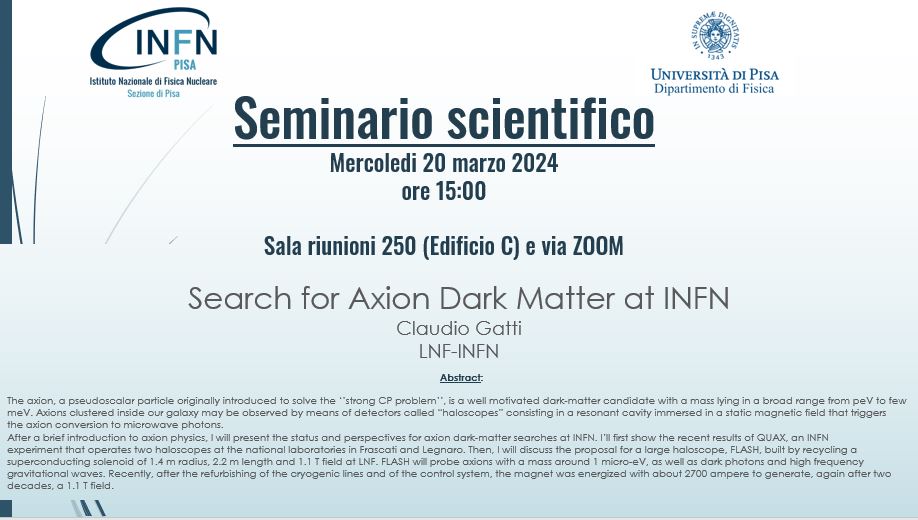




LNF-INFN
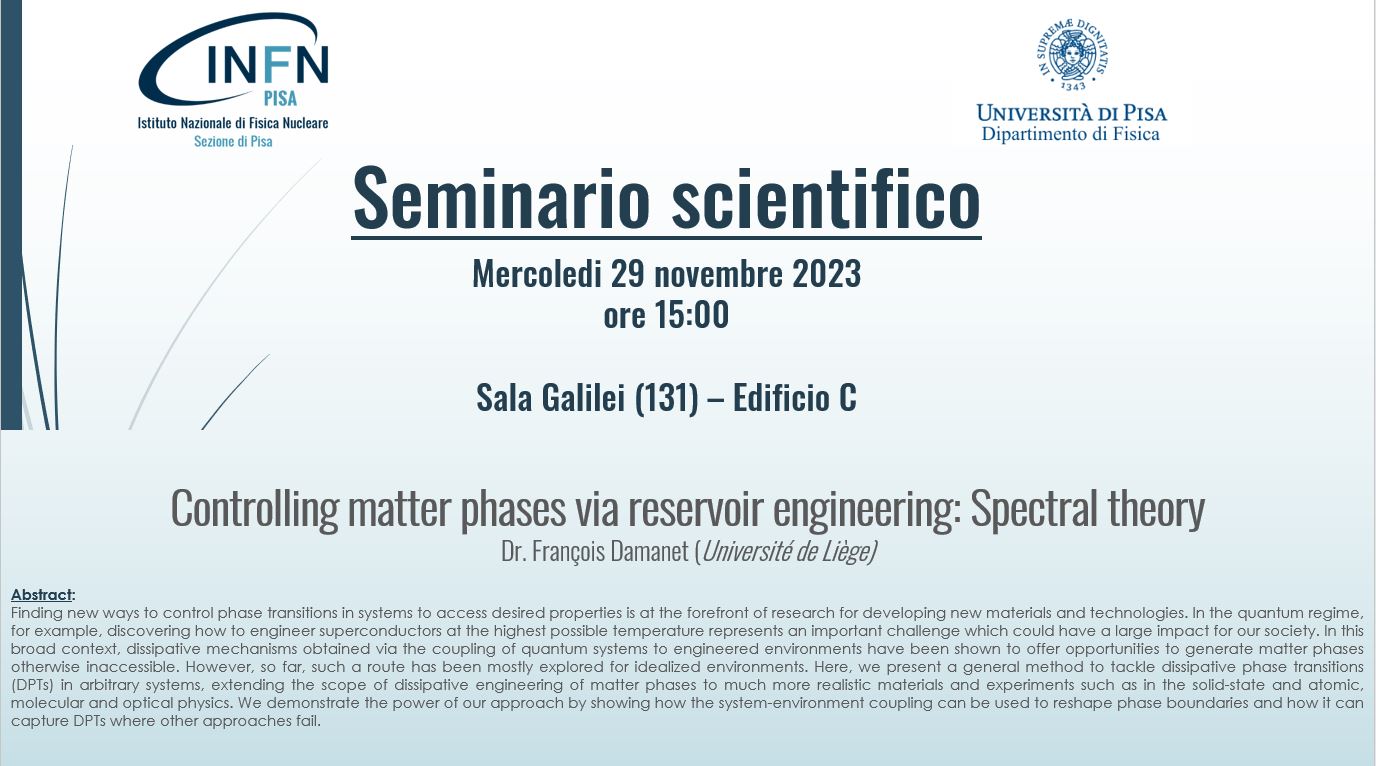
Dr. François Damanet (Université de Liège)
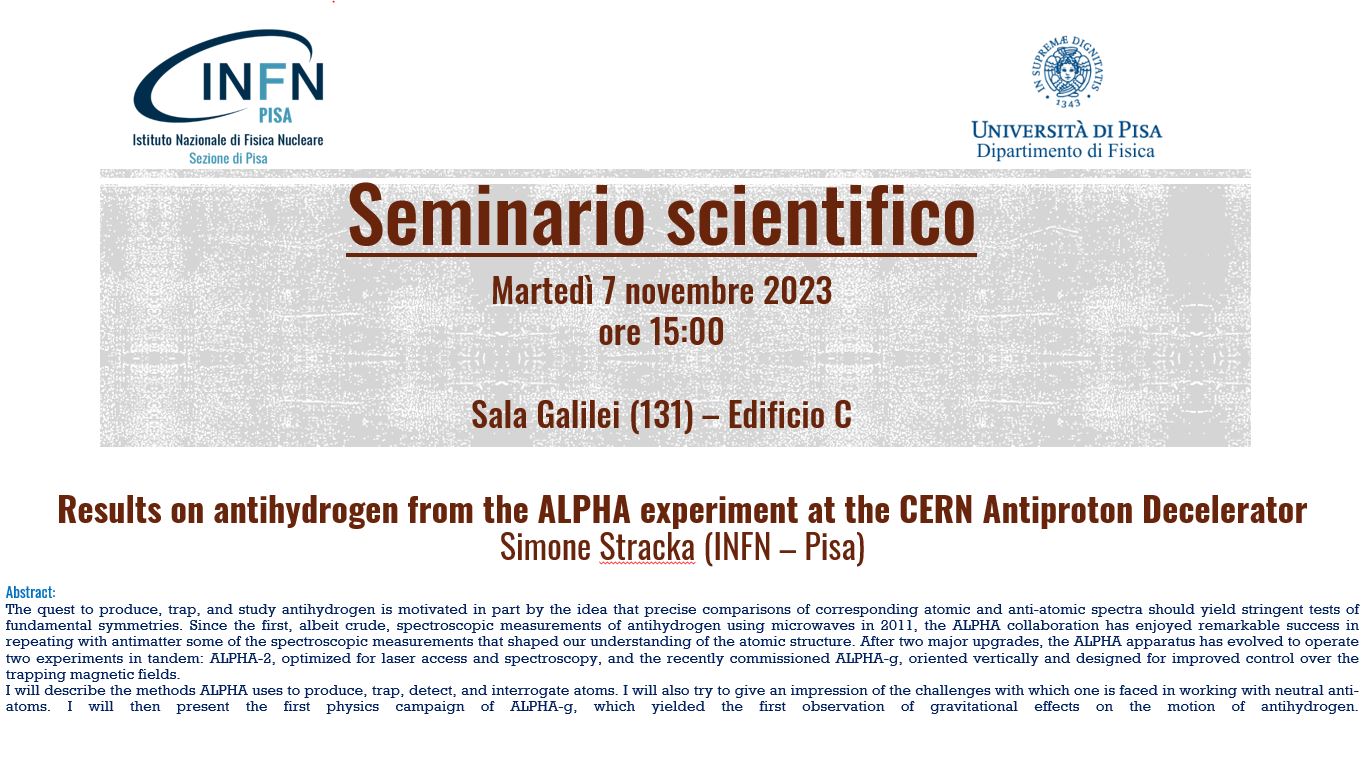
Simone Stracka (INFN – Pisa)
Abstract:
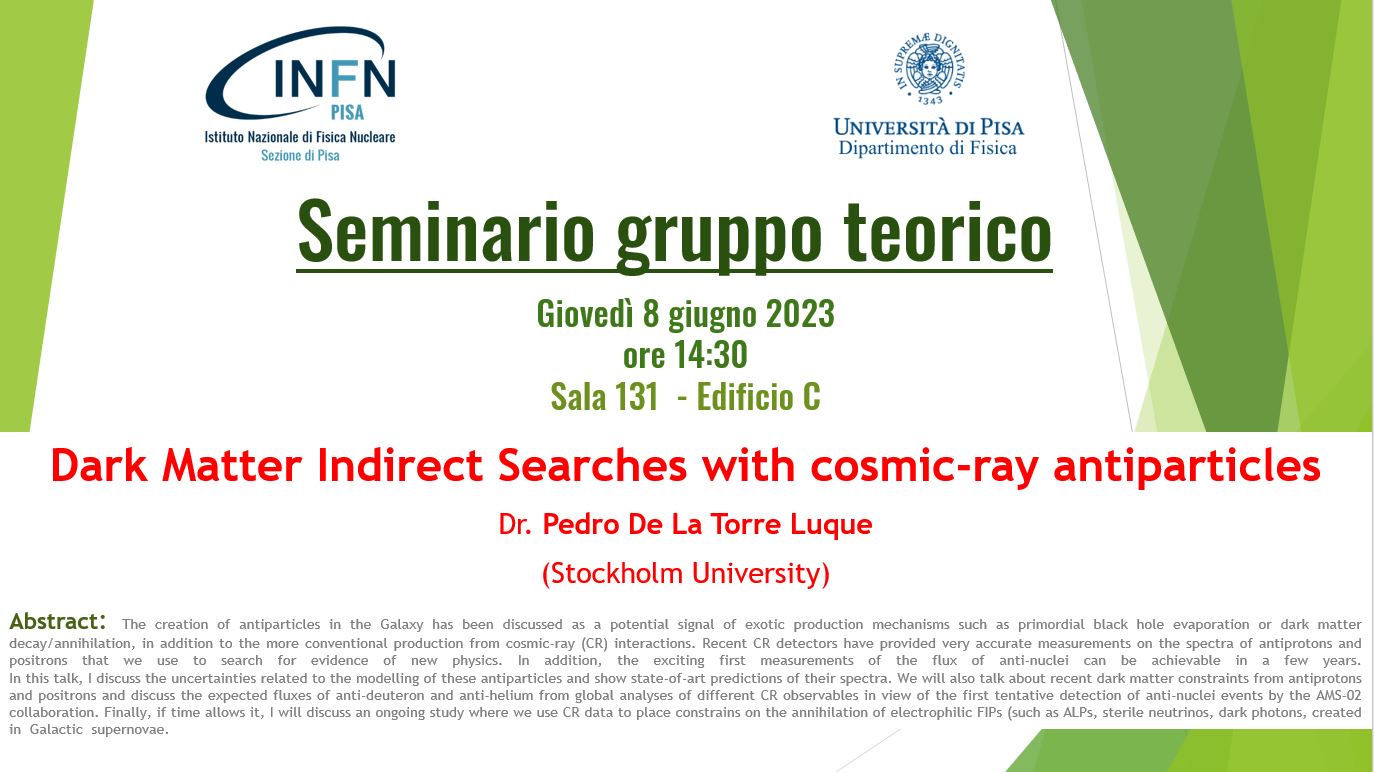
The creation of antiparticles in the Galaxy has been discussed as a potential signal of exotic production mechanisms such as primordial black hole evaporation or dark matter decay/annihilation, in addition to the more conventional production from cosmic-ray (CR) interactions. Recent CR detectors have provided very accurate measurements on the spectra of antiprotons and positrons that we use to search for evidence of new physics. In addition, the exciting first measurements of the flux of anti-nuclei can be achievable in a few years.
In this talk, I discuss the uncertainties related to the modelling of these antiparticles and show state-of-art predictions of their spectra. We will also talk about recent dark matter constraints from antiprotons and positrons and discuss the expected fluxes of anti-deuteron and anti-helium from global analyses of different CR observables in view of the first tentative detection of anti-nuclei events by the AMS-02 collaboration. Finally, if time allows it, I will discuss an ongoing study where we use CR data to place constrains on the annihilation of electrophilic FIPs (such as ALPs, sterile neutrinos, dark photons, …) created in Galactic supernovae.
Collegamento ZOOM
https://infn-it.zoom.us/j/84261721878?pwd=MDZNaGdBUlcvUUJXa2phSHZVZk5sdz09
Abstract:
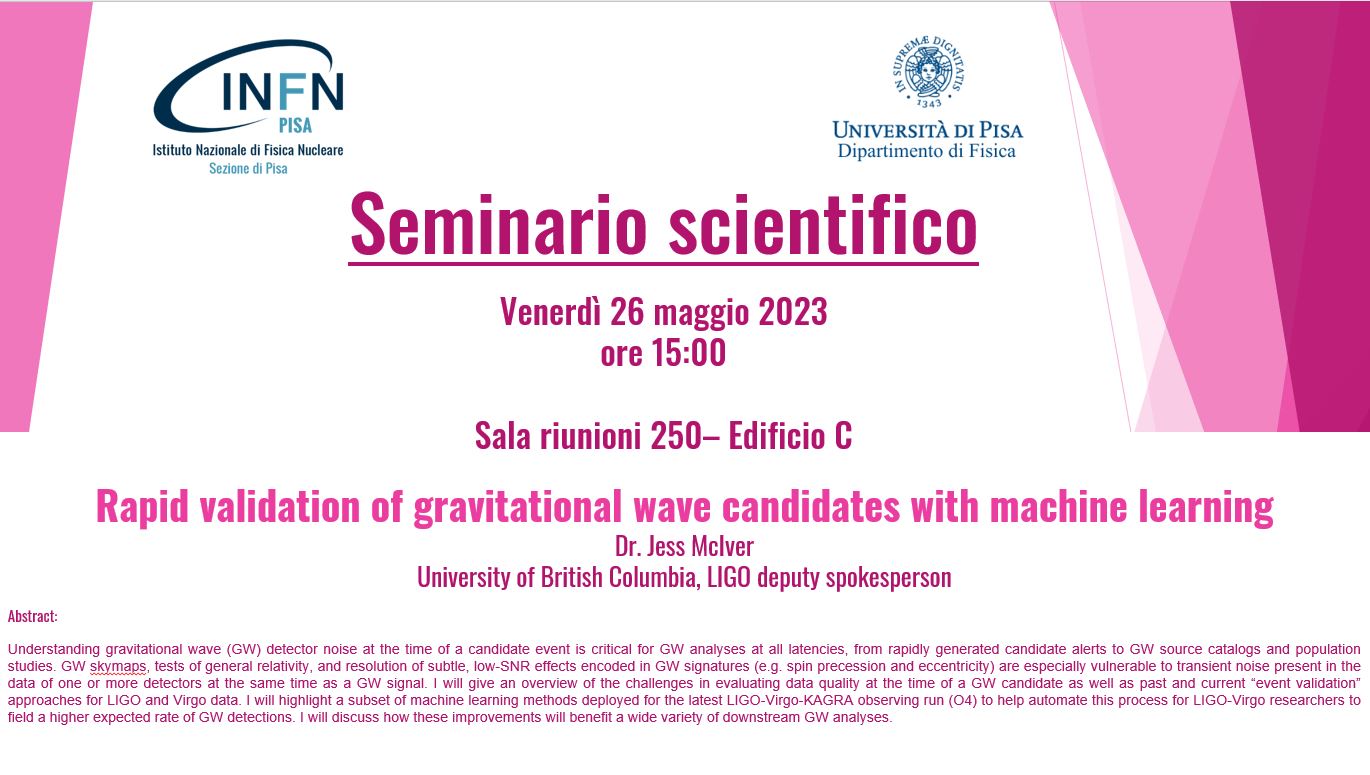
Understanding gravitational wave (GW) detector noise at the time of a candidate event is critical for GW analyses at all latencies, from rapidly generated candidate alerts to GW source catalogs and population studies. GW skymaps, tests of general relativity, and resolution of subtle, low-SNR effects encoded in GW signatures (e.g. spin precession and eccentricity) are especially vulnerable to transient noise present in the data of one or more detectors at the same time as a GW signal. I will give an overview of the challenges in evaluating data quality at the time of a GW candidate as well as past and current “event validation” approaches for LIGO and Virgo data. I will highlight a subset of machine learning methods deployed for the latest LIGO-Virgo-KAGRA observing run (O4) to help automate this process for LIGO-Virgo researchers to field a higher expected rate of GW detections. I will discuss how these improvements will benefit a wide variety of downstream GW analyses.
Coordinate ZOOM:
https://infn-it.zoom.us/j/84261721878?pwd=MDZNaGdBUlcvUUJXa2phSHZVZk5sdz09
ID riunione: 842 6172 1878
Passcode: 611379
Abstract:
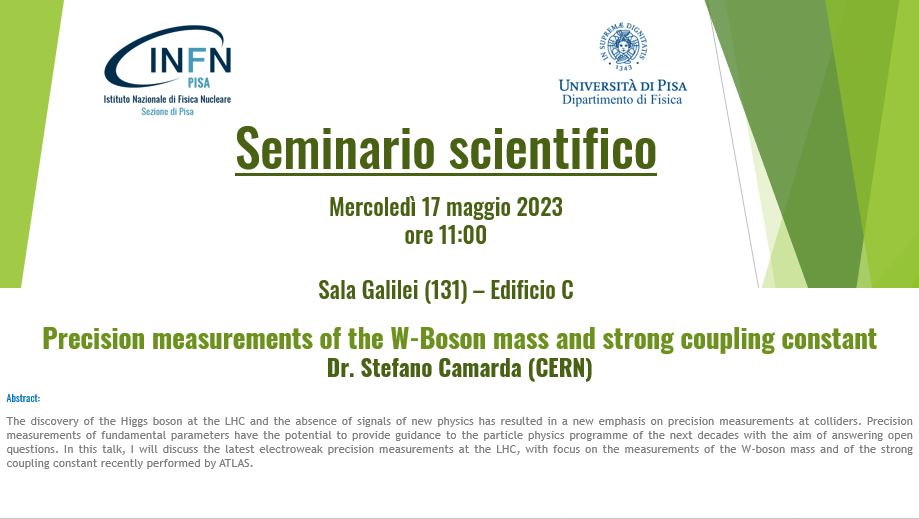
The discovery of the Higgs boson at the LHC and the absence of signals of new physics has resulted in a new emphasis on precision measurements at colliders. Precision measurements of fundamental parameters have the potential to provide guidance to the particle physics programme of the next decades with the aim of answering open questions. In this talk, I will discuss the latest electroweak precision measurements at the LHC, with focus on the measurements of the W-boson mass and of the strong coupling constant recently performed by ATLAS.
Coordinate ZOOM:
https://infn-it.zoom.us/j/84261721878?pwd=MDZNaGdBUlcvUUJXa2phSHZVZk5sdz09
ID riunione: 842 6172 1878
Passcode: 611379
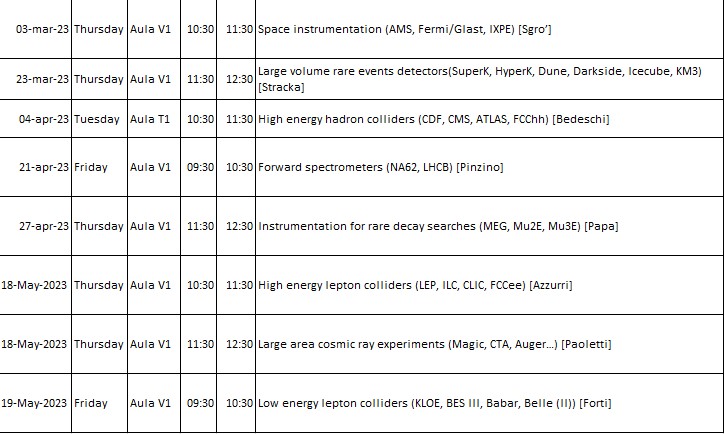
In the context of the course “Instrumentation for Fundamental Interaction Physics” of the Laurea Magistrale, a number of instrumentation seminars have been organized, asking experts to summarize at the basic level how different detector techniques are applied in various experimental domains.
Since these seminars can be of interest to wider audience, let me share the full calendar. Feel free to forward it to potentially interested people.
No remote streaming is foreseen for the seminars.
| 23-Mar-2023 | Thursday | Aula V1 | 10:30 | 11:30 | Space instrumentation (AMS, Fermi/Glast, IXPE) [Sgro’] |
| 23-Mar-2023 | Thursday | Aula V1 | 11:30 | 12:30 | Large volume rare events detectors(SuperK, HyperK, Dune, Darkside, Icecube, KM3) [Stracka] |
| 4-Apr-2023 | Tuesday | Aula T1 | 10:30 | 11:30 | High energy hadron colliders (CDF, CMS, ATLAS, FCChh) [Bedeschi] |
| 21-Apr-2023 | Friday | Aula V1 | 9:30 | 10:30 | Forward spectrometers (NA62, LHCB) [Pinzino] |
| 27-Apr-2023 | Thursday | Aula V1 | 11:30 | 12:30 | Instrumentation for rare decay searches (MEG, Mu2E, Mu3E) [Papa] |
| 18-May-2023 | Thursday | Aula V1 | 10:30 | 11:30 | High energy lepton colliders (LEP, ILC, CLIC, FCCee) [Azzurri] |
| 18-May-2023 | Thursday | Aula V1 | 11:30 | 12:30 | Large area cosmic ray experiments (Magic, CTA, Auger…) [Paoletti] |
| 19-May-2023 | Friday | Aula V1 | 9:30 | 10:30 | Low energy lepton colliders (KLOE, BES III, Babar, Belle (II)) [Forti] |
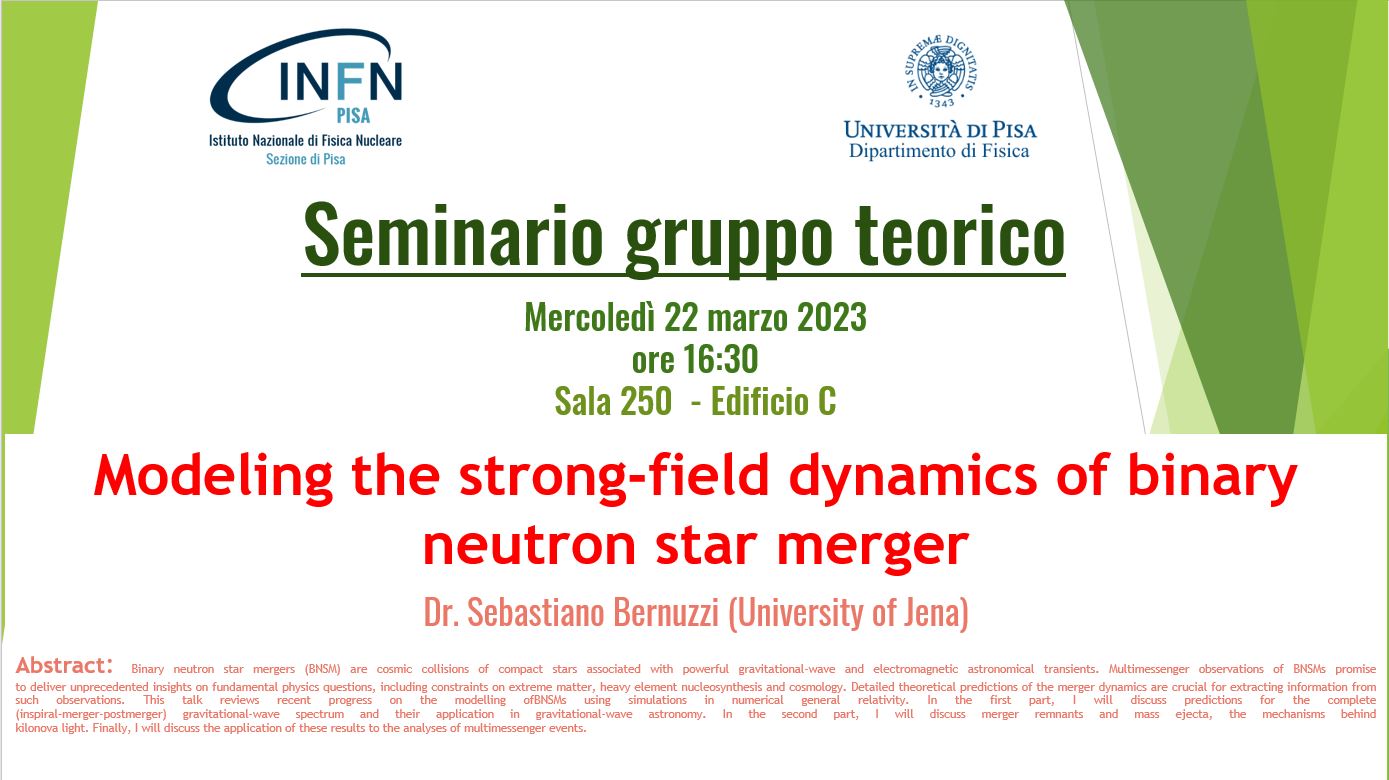
Abstract: Binary neutron star mergers (BNSM) are cosmic collisions of compact stars associated with powerful gravitational-wave and electromagnetic astronomical transients. Multimessenger observations of BNSMs promise
to deliver unprecedented insights on fundamental physics questions, including constraints on extreme matter, heavy element nucleosynthesis and cosmology. Detailed theoretical predictions of the merger dynamics are crucial for extracting information from such observations. This talk reviews recent progress on the modelling ofBNSMs using simulations in numerical general relativity. In the first part, I will discuss predictions for the complete
(inspiral-merger-postmerger) gravitational-wave spectrum and their application in gravitational-wave astronomy. In the second part, I will discuss merger remnants and mass ejecta, the mechanisms behind
kilonova light. Finally, I will discuss the application of these results to the analyses of multimessenger events.
Pagina indico: https://agenda.infn.it/event/34718/