
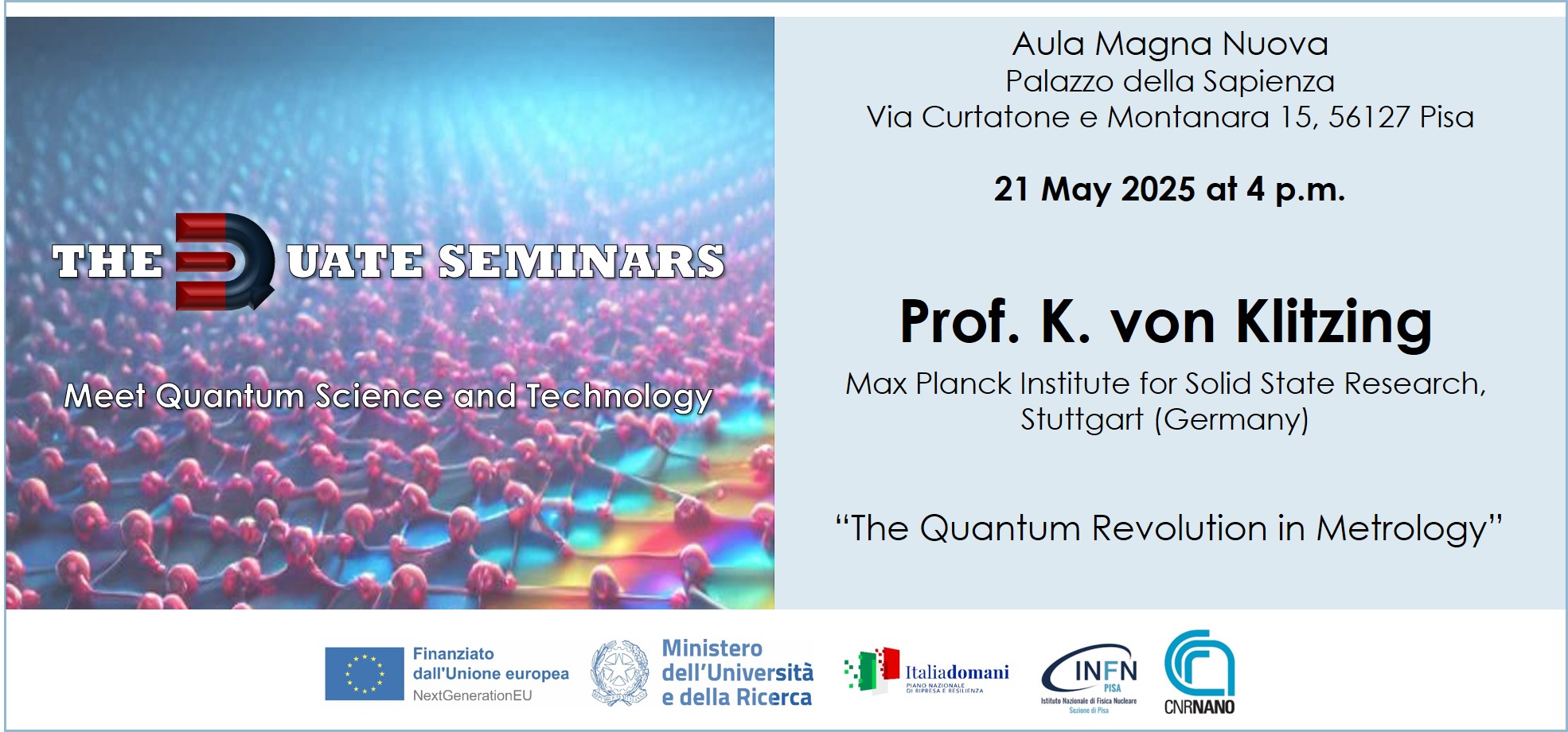
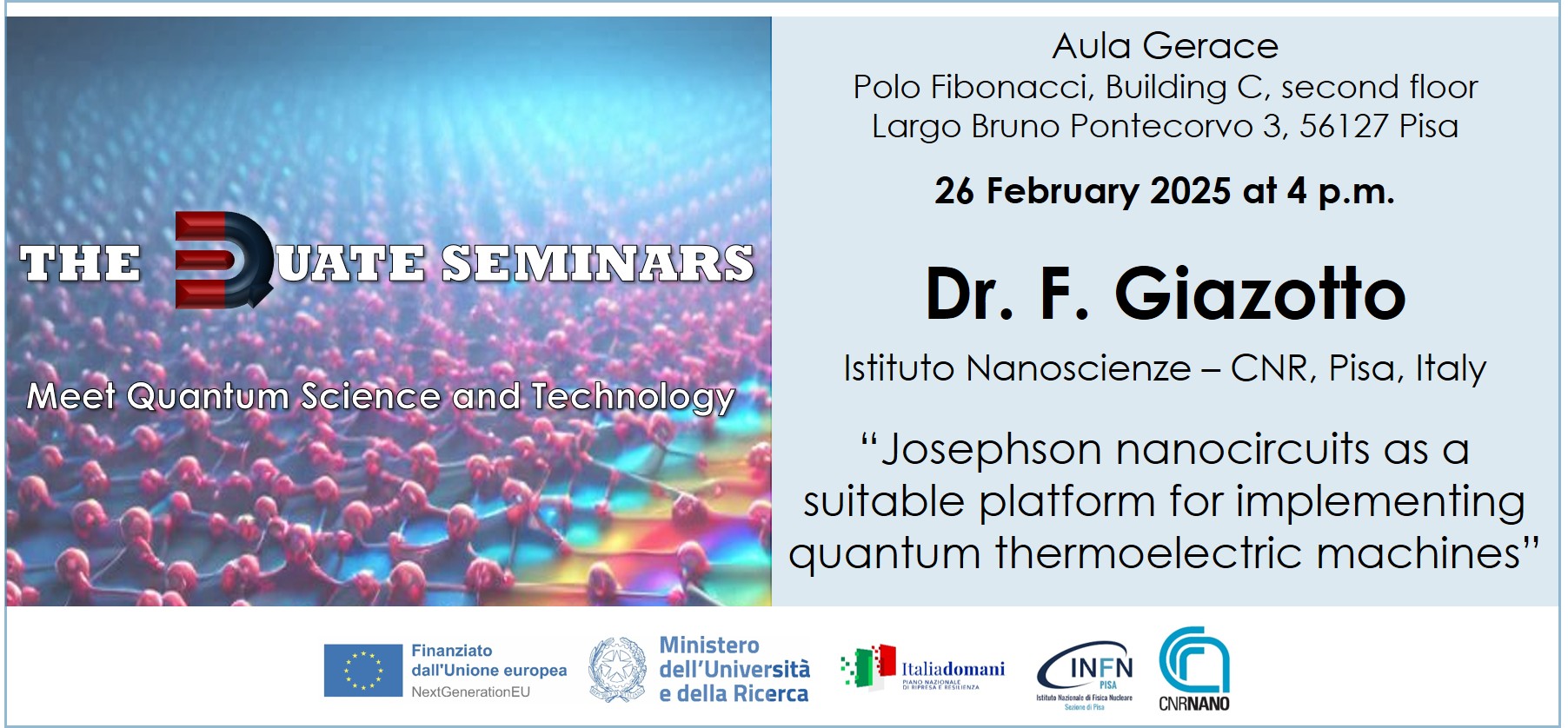
EQUATE Seminars: “The Quantum Revolution in Metrology” – Prof. K. von Klitzing (Max Planck Institute for Solid State Research)

Aula Magna Nuova, Palazzo della Sapienza, Università di Pisa, mercoledi 21 maggio 2025 alle ore 16.00

Abstract: “As a contribution to the 2025 International Year of Quantum Science and Technology, the talk will summarize the impact of the quantum Hall effect in this field with a focus on quantum metrology.
Basic research on the most important device in microelectronic, the silicon field effect transistor, led to the unexpected discovery of the quantum Hall effect and the Nobel Prize in Physics in 1985. This discovery initiated a revolution in metrology, leading to the worldwide introduction of an International System of Units based on constants of nature.”
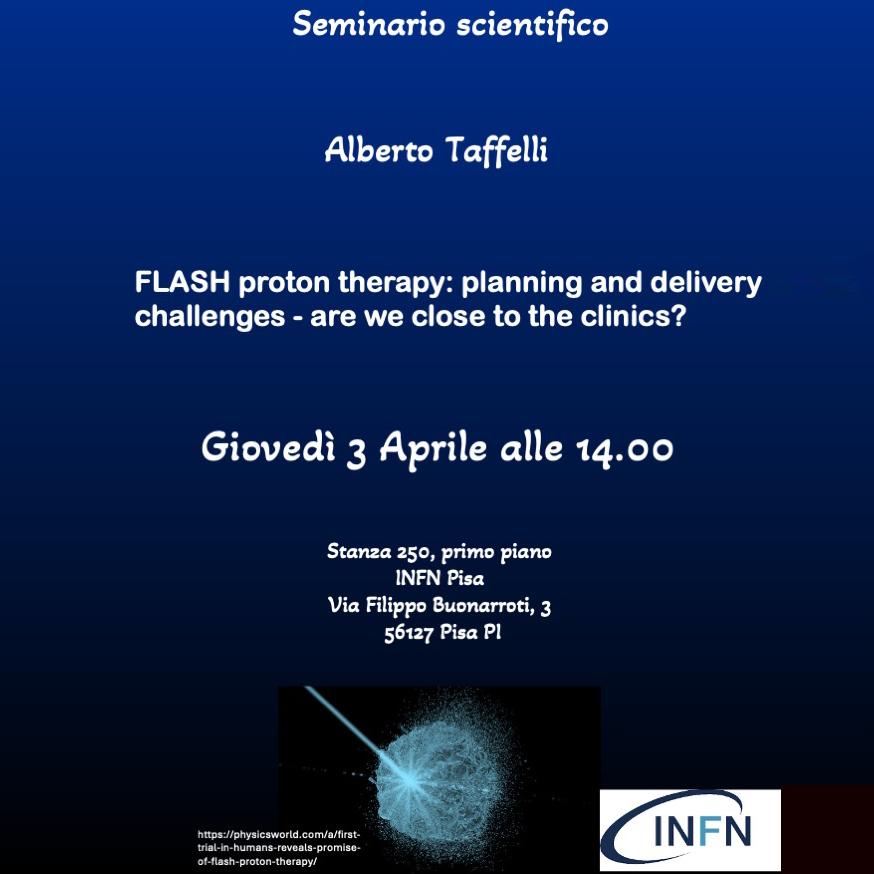
FLASH proton therapy: planning and delivery challenges – are we close to the clinics?

The discovery of the FLASH effect in radiotherapy has sparked an immense collaborative effort within the scientific community to tackle the new challenges and opportunities it presents. This effect occurs when radiation is delivered at ultra-high dose rates (UHDR >40 Gy/s), and it has been observed to differentially damage irradiated cells — effectively targeting tumor cells while sparing healthy ones. Although the underlying mechanism of the FLASH effect remains unclear, new approaches to dose delivery and treatment planning are being actively explored, with researchers patiently awaiting mechanistic insights.
Among the various radiotherapeutic techniques, in the next future proton therapy is expected to stand out as the most promising candidate method to deliver UHDR treatments for deep-seated tumors, maximizing the potential benefits of the FLASH effect. However, significant challenges remain in adapting proton delivery systems to operate under FLASH conditions, as well as in optimizing proton therapy treatment planning, where a clear definition of the key metrics is still lacking.
I hereby present an overview of recent advances in the field of FLASH proton therapy and how research and clinical practice have leveraged the FLASH effect in recent years. In this context, the Trento section of INFN (TIFPA) is playing a pivotal role, supported by the Trento Proton Therapy Center (APSS). An experimental FLASH proton beam is now available, and initial radiobiological experiments have already been conducted. Research on proton FLASH treatment planning is also progressing, paving the way for future clinical applications.

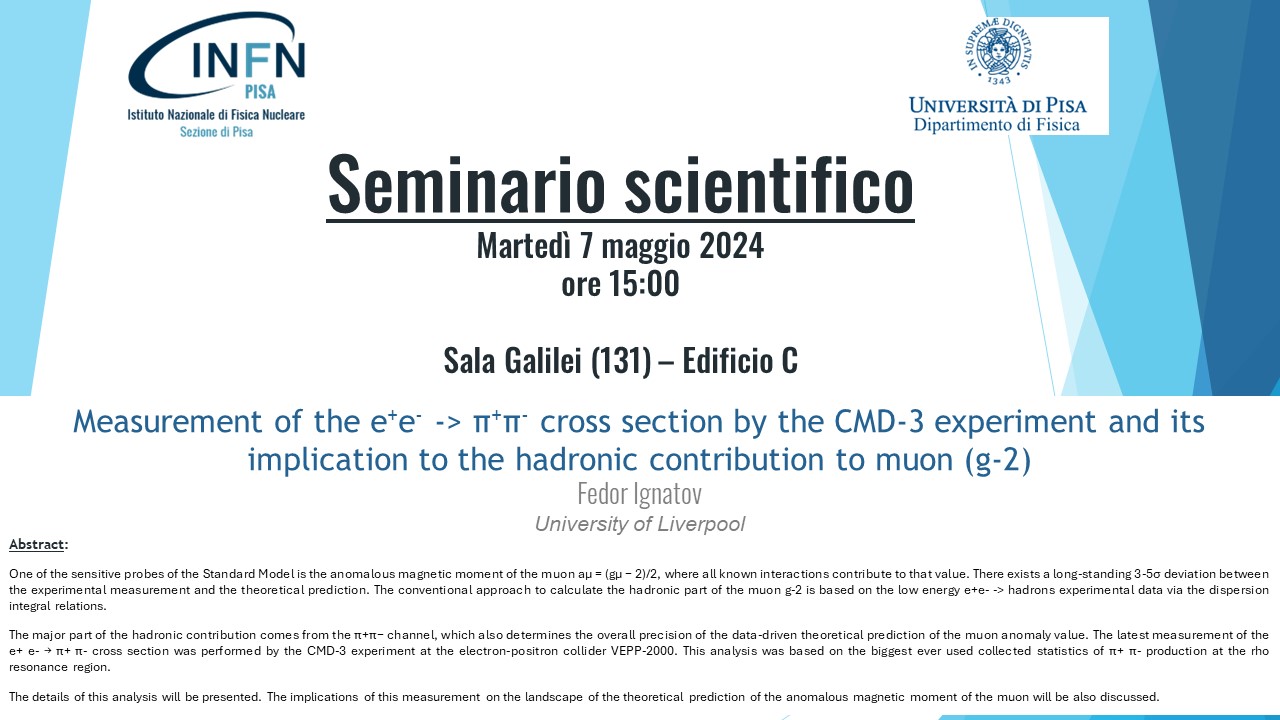
Ciclo di seminari “Armi nucleari, disarmo e proliferazione”

Il Dipartimento di Fisica propone un ciclo di seminari su “Armi Nucleari, disarmo e proliferazione”.

Il primo incontro, dal titolo “Climate Consequences of a Limited Nuclear Exchange” si terrà il 6 maggio 2024, dalle 16:30 alle 18:30, nella sala Galilei dell’edificio C, area Pontecorvo.
Il seminario sarà tenuto da Venance Journé, ricercatrice del Laboratoire de Météorologie Dynamique di Parigi, che studia i rischi legati alle esplosioni nucleari e i cambiamenti climatici.

I prossimi incontri si terranno:

  • il 13 maggio: “L’intelligenza artificiale nel sistema di comando, controllo e comunicazione nucleare
  • il 20 maggio: “La militarizzazione dell’intelligenza artificiale e i sistemi di arma autonomi

Per maggiori informazioni:

I seminari si inquadrano nelle attività del Dipartimento di Fisica come Dipartimento di Eccellenza MUR 2023-2027.