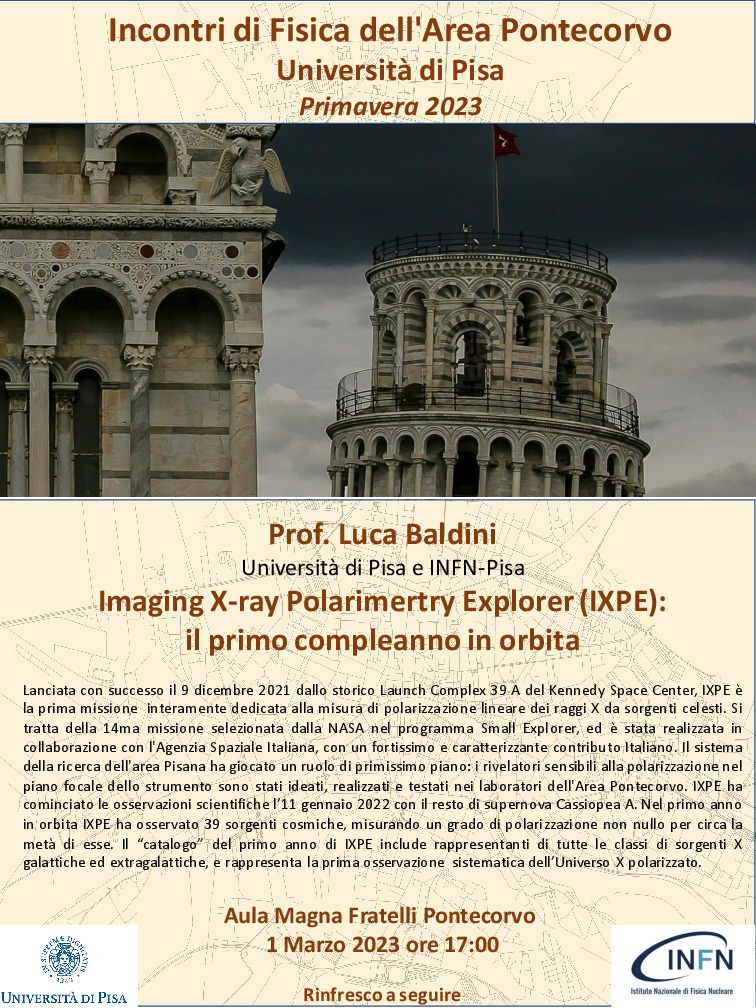
Imaging X-ray Polarimetry Explorer (IXPE): il primo compleanno in orbita (Luca Baldini, Università di Pisa / INFN)




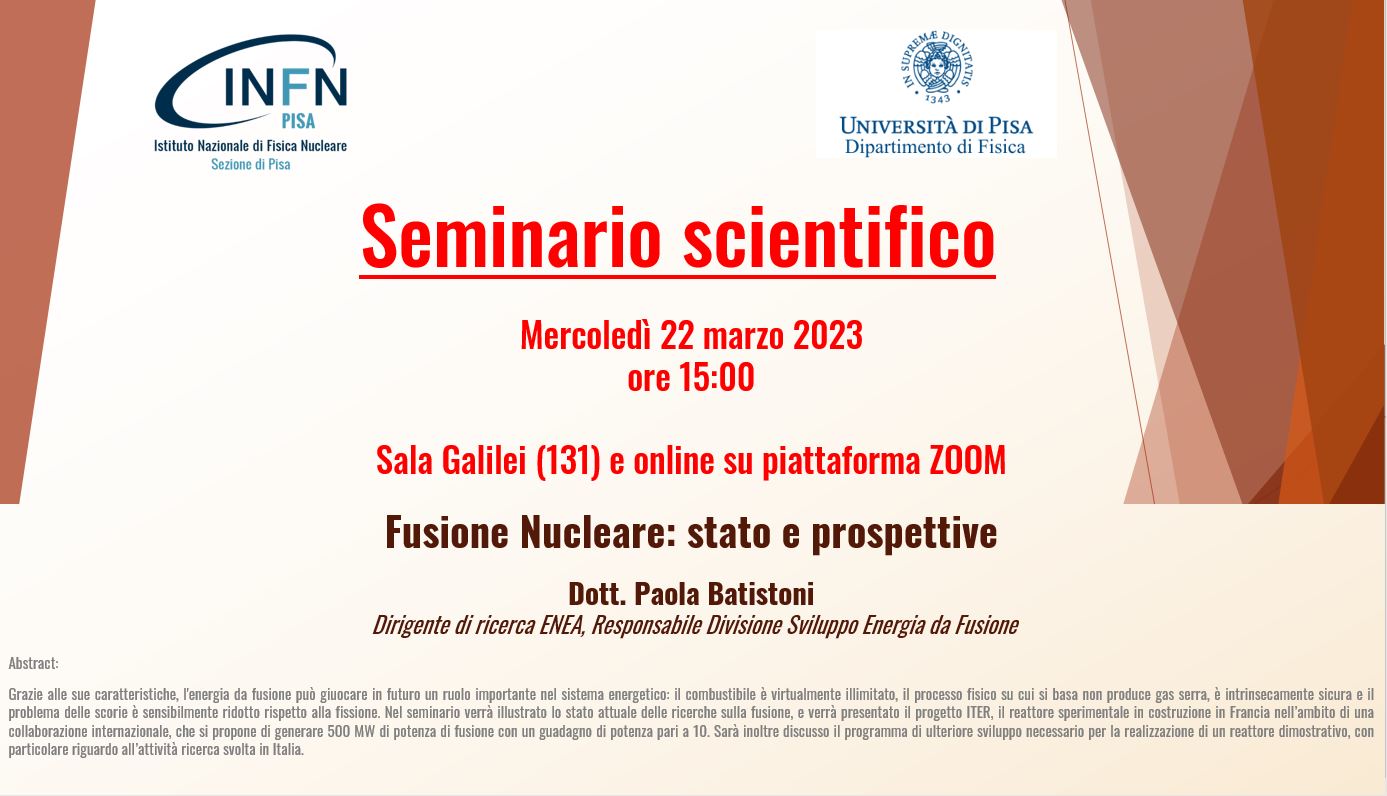
Mercoledì 22 marzo 2023
ore 15:00
Sala 131 e on line su piattaforma ZOOM
Abstract: Grazie alle sue caratteristiche, l’energia da fusione può giuocare in futuro un ruolo importante nel sistema energetico: il combustibile è virtualmente illimitato, il processo fisico su cui si basa non produce gas serra, è intrinsecamente sicura e il problema delle scorie è sensibilmente ridotto rispetto alla fissione.
Nel seminario verrà illustrato lo stato attuale delle ricerche sulla fusione, e verrà presentato il progetto ITER, il reattore sperimentale in costruzione in Francia nell’ambito di una collaborazione internazionale, che si propone di generare 500 MW di potenza di fusione con un guadagno di potenza pari a 10. Sarà inoltre discusso il programma di ulteriore sviluppo necessario per la realizzazione di un reattore dimostrativo, con particolare riguardo all’attività ricerca svolta in Italia.
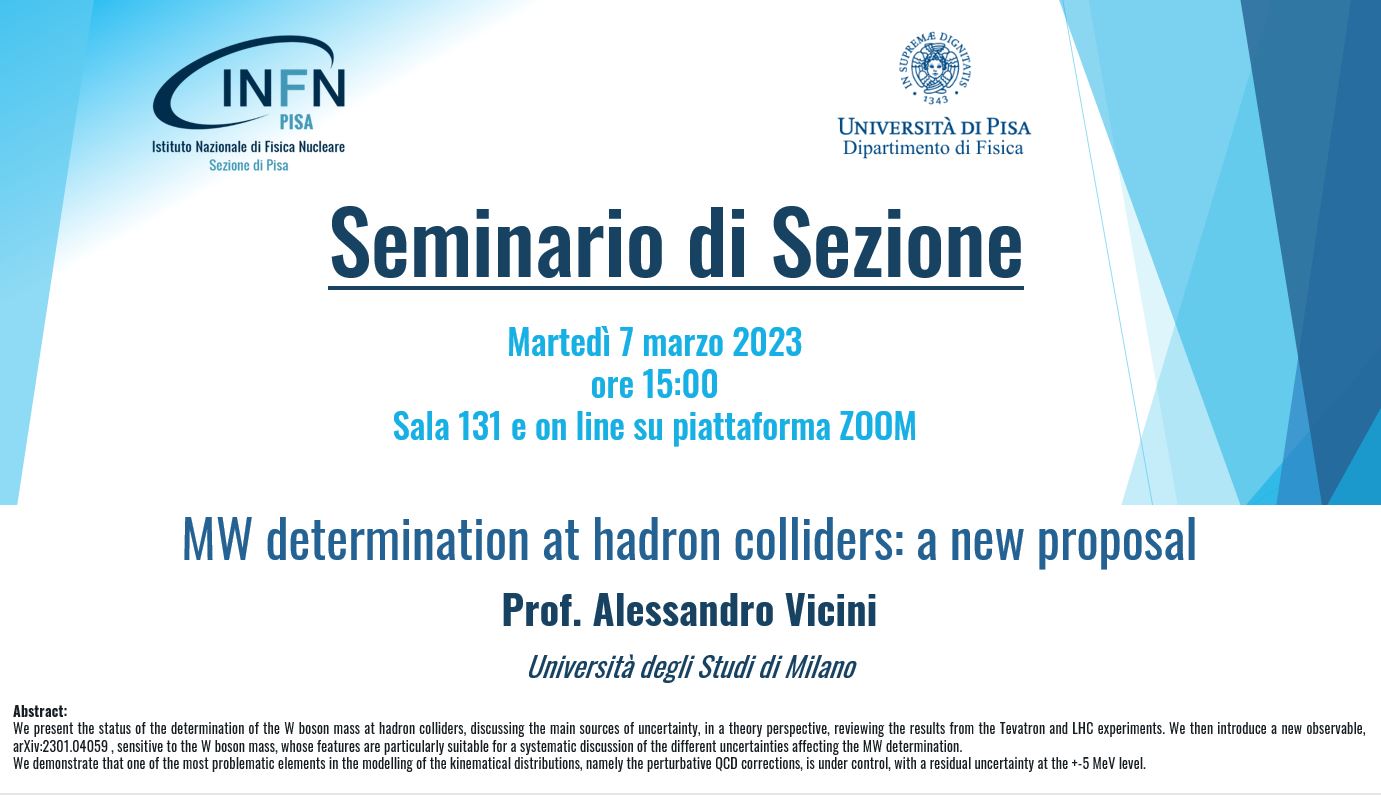
Martedì 7 marzo 2023
ore 15:00
Sala 131 e on line su piattaforma ZOOM
Abstract:
We present the status of the determination of the W boson mass at hadron colliders, discussing the main sources of uncertainty, in a theory perspective, reviewing the results from the Tevatron and LHC experiments. We then introduce a new observable, arXiv:2301.04059 , sensitive to the W boson mass, whose features are particularly suitable for a systematic discussion of the different uncertainties affecting the MW determination.
We demonstrate that one of the most problematic elements in the modelling of the kinematical distributions, namely the perturbative QCD corrections, is under control, with a residual uncertainty at the +-5 MeV level.
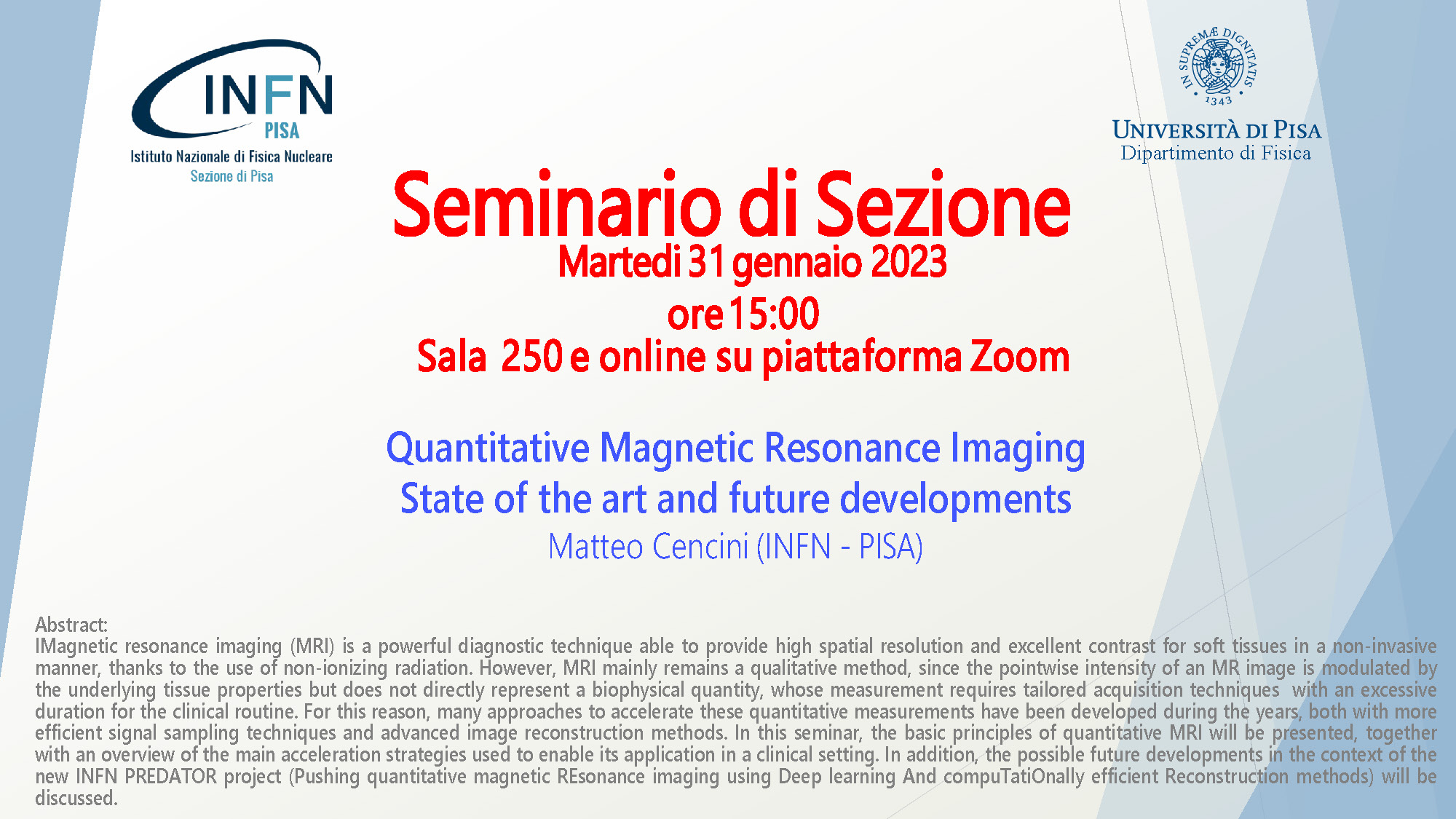
Martedi 31 gennaio alle ore 15.00
Abstract: Magnetic resonance imaging (MRI) is a powerful diagnostic technique able to provide high spatial resolution and excellent contrast for soft tissues in a non-invasive manner, thanks to the use of non-ionizing radiation. However, MRI mainly remains a qualitative method, since the pointwise intensity of an MR image is modulated by the underlying tissue properties but does not directly represent a biophysical quantity, whose measurement requires tailored acquisition techniques with an excessive duration for the clinical routine.
For this reason, many approaches to accelerate these quantitative measurements have been developed during the years, both with more efficient signal sampling techniques and advanced image reconstruction methods.
In this seminar, the basic principles of quantitative MRI will be presented, together with an overview of the main acceleration strategies used to enable its application in a clinical setting. In addition, the possible future developments in the context of the new INFN PREDATOR project (Pushing quantitative magnetic REsonance imaging using Deep learning And compuTatiOnally efficient Reconstruction methods) will be discussed.
Il seminario si terrà in presenza nella sala 250 e via zoom al seguente indirizzo:
https://infn-it.zoom.us/j/84261721878?pwd=MDZNaGdBUlcvUUJXa2phSHZVZk5sdz09
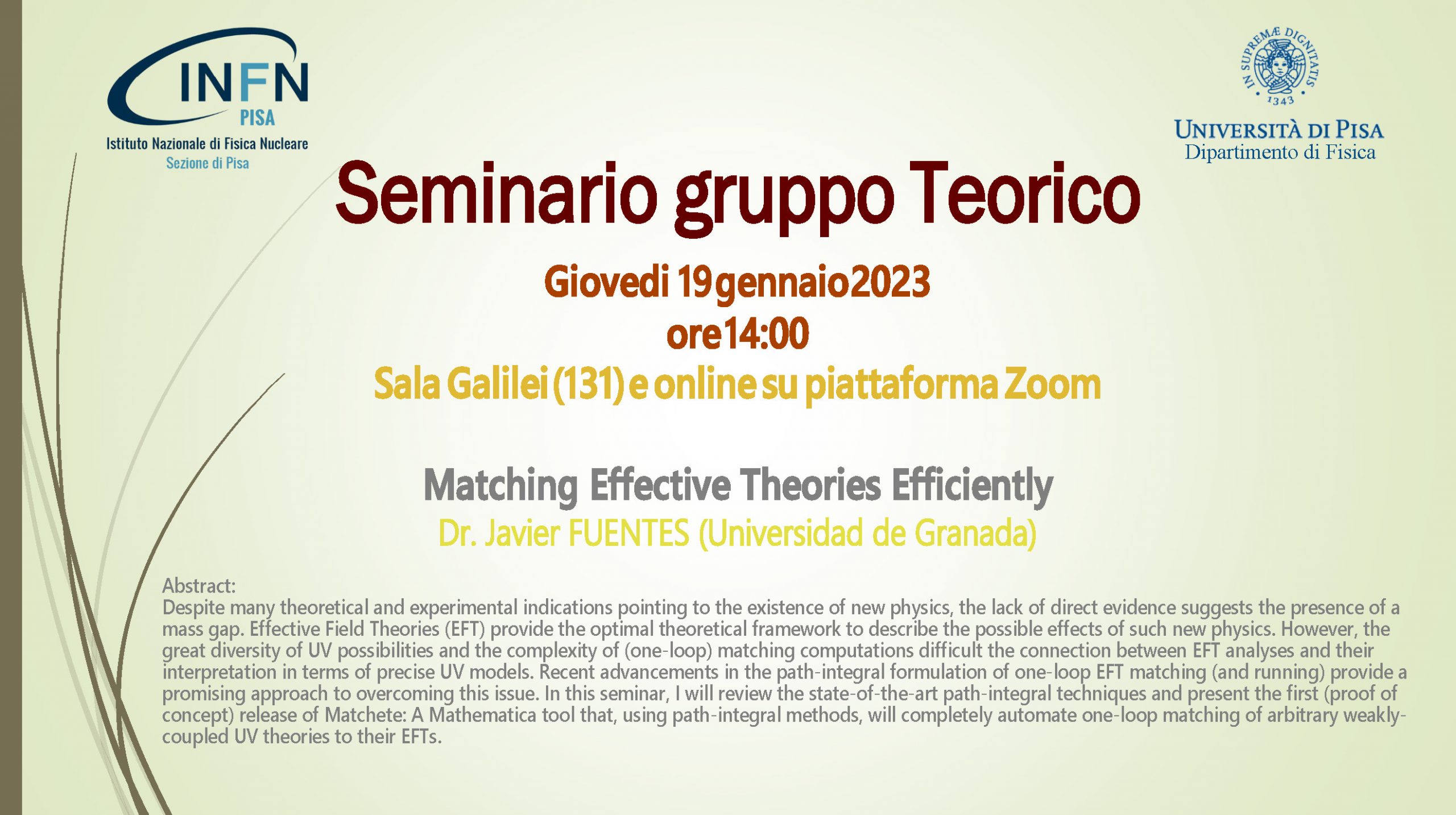
Giovedi 19 gennaio 2023 ore 14:00
Abstract:
Despite many theoretical and experimental indications pointing to the existence of new physics, the lack of direct evidence suggests the presence of a mass gap. Effective Field Theories (EFT) provide the optimal theoretical framework to describe the possible effects of such new physics. However, the great diversity of UV possibilities and the complexity of (one-loop) matching computations difficult the connection between EFT analyses and their interpretation in terms of precise UV models. Recent advancements in the path-integral formulation of one-loop EFT matching (and running) provide a promising approach to overcoming this issue. In this seminar, I will review the state-of-the-art path-integral techniques and present the first (proof of concept) release of Matchete: A Mathematica tool that, using path-integral methods, will completely automate one-loop matching of arbitrary weakly-coupled UV theories to their EFTs.
Il seminario si terrà in presenza nella sala Galilei (131) e via zoom al seguente indirizzo: https://infn-it.zoom.us/j/84261721878?pwd=MDZNaGdBUlcvUUJXa2phSHZVZk5sdz09