Researchers from Gruppo Collegato di Siena (
INFN ) partecipate in the
AMS-02 experiment on board of the International Space Station (ISS). In a joint effort with the INFN group
AMS-Pisa , it contributes to the construction of the Electromagnetic Calorimeter (ECAL) of AMS, in collaboration with
LAPP (France),
IHEP Beijing (China).
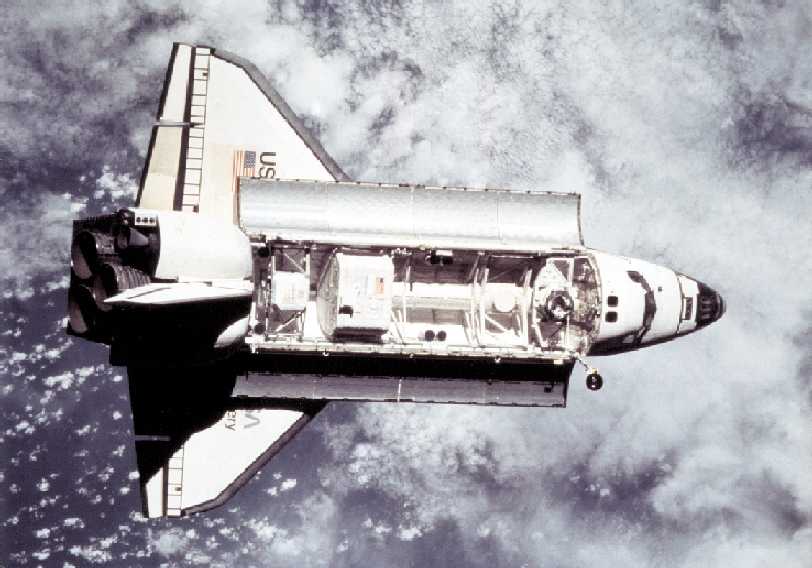
The AMS-02 experiment has been approved by NASA to operate on the International Space Station (ISS). A precursor flight (AMS-01) took place in June 1998 on board of the Shuttle Discovery (STS-91).
The main scientific goals of the AMS-02 experiment are :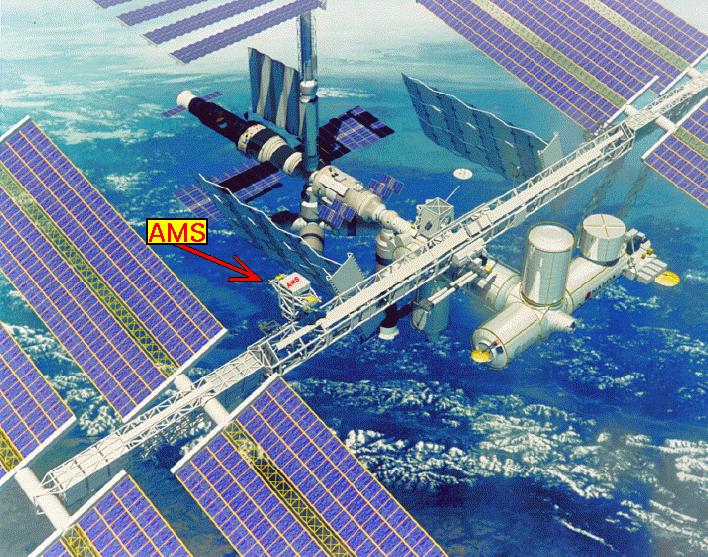
- Search for Anti-Matter (anti-He and anti-C) in space, with a sensitivity 104 to 105 times better than the current limits.
-
- Search for Dark Matter by high statistics precision measurements of antiprotons, positrons and gamma spectra.
-
- High statistics measurements of D,3He, B, C, 9Be and 10Be spectra.
-
-
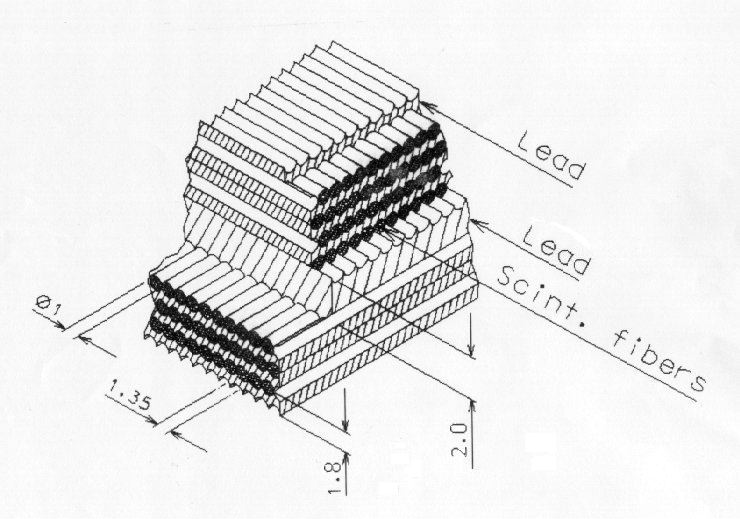
The electromagnetic calorimeter of AMS is a high granularity (Pb-SCNT) sampling-calorimeter with 1 mm scintillating fibers embedded into lead. This composite structure is built out of layers of 1 mm thin grooved lead planes with fibers glued in between.The very small lead foil thickness results in a quasi-homogeneous structure easy to be machined and of considerable stiffness. Fibers are alternatively directed along the x and y axis : the fiber direction is changed every time the fiber-lead stack (superlayer) is 18.5 mm thick. Designed for a total of 16 radiation lengths (RL), the calorimeter is finely segmented longitudinally along the z direction into 18 layers, grouped into 9 super-layers.
Hamamatsu R7600-00-M4 photomultipliers (PMT) will be used as photodetectors. Its 1.8·1.8 cm2 squared photocathode is subdivided into 4 identical quadrants, each matching the thickness of one calorimeter superlayer. The lateral granularity of the calorimeter (72 subdivisions) has been driven by the small Moliere radius and by the dimensions of the photocathode. Consequently, ECAL will be equipped with 324 PMTs, corresponding to a total of 1296 cells.
The main goals of the calorimeter design are :
- to measure the total energy released by neutrals, charged particles and nuclei in the energy range from 1 GeV to 1 TeV, approximately;
-
- to separate electromagnetic showers (electrons and positrons) from hadronic showers (antiprotons and protons, mainly). This is a key issue, for instance, in the measurement of the positron spectrum where cosmic ray (CR) protons have to be suppressed by a factor of ~ 105 or better. In a class of models, dark matter may consist to a large extent of relic neutralinos. Neutralino annihilations may manifest themselves as an excess of particles of a given kind (like p, p-bar, e-, e+ and g). To perform reliable measurements of these particle spectra, one has to isolate them from the background, therefore one needs an excellent electron/hadron (e/h) dicrimination capability.
-
- to image the shower development in 3-D, taking advantage of the fine granularity, and reconstruct the direction of the radiation impinging on the calorimeter. For charged particles, this information is complementary to the tracking performed by the magnetic spectrometer. For high energy photons converting in the calorimeter, it provides their direction with an angular resolution better than 1 degree.